

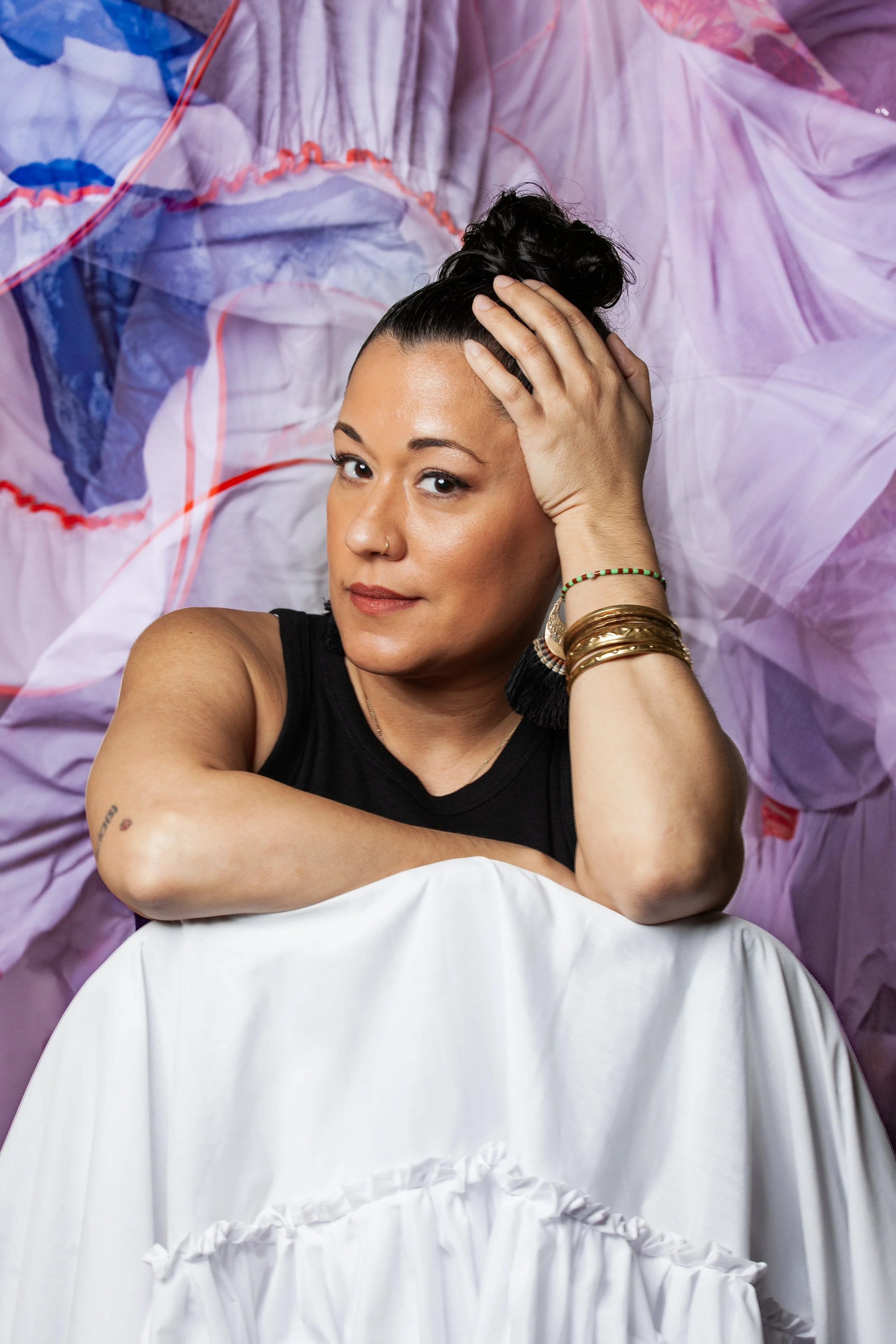
The Laureate of Belonging
Mayda Del Valle
Story by: Maggie Sivit
Photos by: Marisa Klug-Morataya
Mayda Del Valle knows how to move a crowd. Inside the Green Mill, the lights are dim, martini glasses clink, and there’s a clatter of conversation. But as soon as Del Valle steps on stage, the room settles. She’s comfortable at the mic, and the audience, which has been, up until this point, impatient with the poets — responding to long-winded preambles with yells of, “Read the damn poem!” — wants to hear what she has to say. When she starts to sing, the crowd seems taken by surprise, and the sound rings through the room. Mi papá nació en la loma, al lado de un platanal. En esa tierra ancestral, el cielo fue su corona. After the song ends, Del Valle moves seamlessly into prose, a mix of fragmented conversations, incantations, and moments from her life as a caretaker to her father.
It’s fitting that for Del Valle, a multidisciplinary artist who was recently named Chicago’s Poet Laureate, songwriting comes as easily as writing poetry. Music is in her bones. Del Valle spent her early years on Chicago’s Southwest Side, on the edge of the Back of the Yards and West Englewood neighborhoods. “The old neighborhood was loud and raucous,” she told me recently. “There were tons of Puerto Ricans, African Americans, Cubans — people from all over.” Greetings shouted from stoops, hip hop spilling out of open windows, and the litany of Catholic rosaries became the background music of her early years.
In particular, música jíbara played nearly constantly in Del Valle’s childhood home. “I feel a real affinity to that music because of the storytelling in those songs,” she said. “That was something that shaped my aesthetic, shaped the way I talk, shaped the way I write, shaped the way I look at the world.”
Del Valle’s early worldview was also shaped by her community. As a high school student in Chicago Lawn, she got involved with the Southwest Youth Collaborative, an organization that provides arts and cultural programming to young people. Older members of the group invited her to participate in workshops and community murals. “They gave me a lot of space to not just work as an artist, but to share my thoughts and opinions about what it was like being a young person in the neighborhood in the ’90s,” she said.
Ultimately, Del Valle’s mentors at the Southwest Youth Collaborative even helped her go to college — putting her in touch with a recruiter who helped her land a full ride to Williams College in Massachusetts. “I was just a 17-year-old, rushing around,” she said. “But they knew the potential I had.”
Chicago is the birthplace of many things, including the phrase “poetry slam.” It was coined 40 years ago by Marc Smith to describe the Uptown Poetry Slam, which was created, first and foremost, to bring poetry to the people. At the Green Mill, which has been home to the event since the 1980s, Smith takes a moment to remind the audience what it’s all about.
What makes this show different from your ordinary poetry reading?” he asks. “You, the audience, are in control. If you happen to like something, you cheer madly.” The crowd whoops in response. “If you don’t like it a little bit, snap your fingers. If you don’t like it a little bit more, you stomp your feet. And if it’s god-awful bad, you groan.”
While the Uptown Poetry Slam may be the birthplace of the poetry slam, where poets are judged for their performance as much as their writing, the Nuyorican Poets Cafe in New York City helped popularize this type of event. The renowned venue is a longstanding home to artists working outside the mainstream, with a focus on performers from the Puerto Rican diaspora. And it’s the place that served as Del Valle’s launching pad.
Del Valle visited the Nuyorican for the first time as a college freshman, and was immediately drawn to the high-energy, competitive atmosphere. The people she was with encouraged her to sign up for the open mic, but she told them, “I’m not getting on that stage until I’m good enough to win.”
A week before graduation, she went back. College had been socially isolating — “I didn’t want to be there anymore,” she said — but she was riding the high of a poetry performance she’d recently given at school. At the end of the slam, she signed up for the open mic and performed a poem called “Decendancy.” “I got a standing ovation in a room of 25 people at 12 o'clock in the morning,” she said. “And that's when I knew.”
Things happened quickly after that. Del Valle moved to New York City and became a regular at the Nuyorican. In 2001, she won both the Grand Slam and the National Poetry Slam — making her the youngest poet and only Latine person to have done so.
Soon afterward, Del Valle heard they were recruiting for a new HBO show called “Def Poetry Jam,” and got picked to be in the first season. In an early episode, she performed “Decendancy,” the poem that got her a standing ovation at her first Nuyorican open mic. She went on to perform with “Russell Simmons' Def Poetry Jam,” a Broadway show inspired by the television series.
Slamming, influenced heavily by hip hop, taught Del Valle stage presence and how to command a room. “There's moments in hip hop when you're listening to a freestyle, when somebody makes a really dope metaphor, or has a really dope punch line, right?” she said. “You learn how to kind of create moments like that in poetry, too — those lines that just go straight to the jugular.”
When you watch her perform, it’s striking how good Del Valle is at this: knowing how to lure a listener in and drop the floor from under them with an unexpected, unforgettable turn of phrase.
But being focused on the crowd and its reaction began to feel limiting. “If you do that for too long, then you kind of stunt your own development as a writer,” she explained, “because you're constantly writing for an audience.”
Del Valle started writing for herself. After a stint working for a civic engagement campaign in Los Angeles, she enrolled in grad school at Cal Arts. “I loved reading new things, being exposed to new styles that I hadn't really been exposed to before, getting asked to write outside of the box that I had kind of confined myself to,” she said.
While in grad school, she began teaching with Street Poets, an L.A.-based organization that helps young people process trauma, stay out of violence, and find their voice. Del Valle became a mentor to teens in much the same way as she’d been mentored at the Southwest Youth Collaborative.
It was during these years that she wrote most of the poems in The University of Hip-Hop and A South Side Girl’s Guide to Love & Sex.
While the poems in these collections may not have been written for an audience, they come alive when performed. At the Green Mill, Del Valle holds a worn copy of A South Side Girl’s Guide to Love & Sex and reads her poem “Why you talk like that? or the Etymology of ‘Where are You Really From?’.” She has an intense, magnetic stage presence. People laugh, caught off guard by the directness of her opening, before she winds them into a poem that turns from English to Spanish and back again, an interrogation of language and place and belonging. The crowd is swept up, backchanneling in recognition, rocking with the rhythm of her words.
In 2017, Del Valle left California and moved back to Chicago to take care of her father, who was then in the early stages of Alzheimer’s. It was an uneasy homecoming. “Here I am in my late 30s, moving back home and starting over, alone, with none of the things that everybody tells you you're supposed to have in place,” she said. “No relationship, no kids, no job — not even a car.”
She began to build a new life. But the next few years were marked by grief. She lost two pregnancies. A relationship ended. Her job in tech — which had buoyed her financially, even if it hadn’t left room for creative pursuits — ended abruptly when the company went through layoffs.
Eventually, Del Valle started working at the Chicago Poetry Center, and tethered herself to teaching. “The kids got me through,” she said. “It sustained me. While all these things were shifting around me — my dad and my life and my body and my health and relationships and all of this stuff — I realized, let me just be here. Let me just deal with this period of loss, and mourn, and grieve, and heal.”
During particularly low moments, Del Valle said she stopped considering herself a writer. “I thought, maybe that’s a chapter in my life that’s done.”
She found other forms of expression. Del Valle started taking bomba classes at La Escuelita Bombera de Corazón in Humboldt Park, which became an important community for her.
“Bomba has been really instrumental in keeping me creatively connected during moments when my writing was not really coming through, or when I didn't feel like a writer, or when I was avoiding being a writer,” she said. In particular, the music and celebration of culture served as “a bridge to bring me back to language with the songwriting.”
It was the director of La Escuelita, Ivelisse Díaz, who encouraged Del Valle to apply for Letras Boricuas, a fellowship for Puerto Rican writers, which she received in 2024. That was followed by a residency with the Elastic Arts Foundation that she used to develop Herencia, a multidisciplinary project about memory and Puerto Rican identity.
And then, last May, Del Valle applied for the Chicago poet laureateship. A collaboration between the Department of Cultural Affairs and Special Events (DCASE), the Chicago Public Library and the Poetry Foundation. The program was established to honor Chicago’s working poets. The Poet Laureate is selected for a two-year term, during which they create new works and serve as a cultural ambassador for the city. Del Valle was stunned when she got the news she’d been selected. “I always have a lot to say,” she said. “But that day, I had no words.”
Under the bright lights of the auditorium stage, Del Valle begins, once again, to sing.
She’s joined by Jonathan Pacheco, an instructor at La Escuelita, on guitar. Sitting tall, hands resting on her thighs, Del Valle moves fluidly between poetry and song. The décima, a poetic-musical form common in música jíbara with a strict rhyming structure, is one she now incorporates into her work frequently. Pacheco keeps his eyes on her, following her lead.
Today, Del Valle is the keynote speaker at Chicago Poetry Fest at the Harold Washington Library Center. After the performance, she joins playwright Sandra Delgado for a conversation. Delgado asks Del Valle what she sees as the throughline of her artistic lives, from childhood to today.
Del Valle thinks for a moment and then says, “How unapologetically Puerto Rican I am.” She laughs and describes her teenage writings in a recently rediscovered 1997 journal, filled with stories about her mom’s chanclas and the Virgin Mary appearing in a bowl of soup. “I still come back to some of these images,” she says. “It’s a loop. You spiral out, you come back in.”
In the front row of the auditorium sits avery r. young, who served as Chicago’s first Poet Laureate from 2023 to 2025 and set the bar for the position. During his tenure, young was perhaps best known for his “Chicago Soul Poem” project, in which he established a new poetic form and invited Chicagoans to write and record their own poems about the soul of the city. Most recently, he worked with the Chicago Transit Authority to curate a custom train wrap for National Poetry Month, featuring several Illinois poets — including Del Valle — and their poems.
Now, Del Valle is making the role her own, and she has big plans. She’s organizing poetry workshops at community centers and public libraries. Ultimately, she wants to do something big and participatory that reaches every corner of the city. “My dream project as part of the laureateship is a public art project,” she told me, “like a citywide writing campaign that becomes one larger, collective poem, and then turned into a mural.”
A few weeks after our conversation, rushing to the Blue Line, I get to the platform right as the train doors close. Covering the outside of the train car, in a giant, blue-hued design, is Del Valle’s portrait and the bright yellow words “a city that writes together.” The train disappears into the tunnel, taking Del Valle’s image with it — out into the city she has spent her life translating into music and poetry, one line at a time.